


Professor Mirosław Handke (1946–2021)
Rector for the 1993–1998 term of office
Chemistry, physicochemical properties of solids
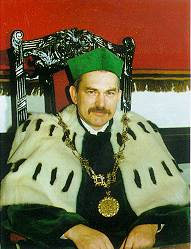
He was born in Leszno. He graduated from the Faculty of Mathematics, Physics and Chemistry of the Jagiellonian University (1969). Since that year, he has been associated with the University of Mining and Metallurgy. A student of Professor Edward Görlich, a Harrick Scientific Corporation Institute scholar in the years 1984–1986 and 1989; in the years 1986–1989 a visiting professor at the University of Genoa, the Institute of Technology in Haifa, Izrael, and TU Clausthal.
He established the structure of the NSZZ “Solidarność” trade union at the AGH and was its vice-president; he also co-founded Małopolski Klub Konserwatywny [Małopolska Conservative Club].
Professor Handke established the AGH Institute of Silicate Chemistry, which was later transformed into the Department of Silicate Chemistry and Macromolecular Compounds of the Faculty of Materials Science and Ceramics. In the years 1993–1998, he was elected rector twice. It was a period of extremely intensive work: the entire organisational structure of the university was transformed (Departments replaced Institutes), as well as its financial system. The new system worked highly efficiently, which allowed the university to come out of a deep financial crisis. Its economic efficiency has been proven ever since, as the system, in an almost identical form, operates to date.
Professor Handke initiated and co-founded The Conference of Rectors of Academic Schools in Poland (CRASP). From October 31, 1997, to July 20, 2000, he held the position of the Minister of National Education. He co-created the education system reform of 1999. It has replaced the two-level education structure, which had been in force since 1968, and introduced 3-year junior secondary schools for young people who had finished 6-grade primary school. Simultaneously, a common system of external examinations for primary and junior secondary school leavers was introduced. The principles of the final school-leaving exams were thoroughly changed, reintroducing the obligation to pass a mathematics exam. Due to the standardisation of the new school-leaving exams, they have replaced admission (or entrance) exams at universities. The reform also implied closing technical secondary schools and vocational secondary schools and transforming them into a system of post-exam schools. Training colleges were established.
Professor Handke published about 150 papers, 103 of which are listed on Google Scholar and, according to this publisher, were cited about 1200 times; the h-index is 20. The numbers listed pertain to Professor Handke’s publications on the chemistry of solids and oscillatory spectroscopy that were published after 1985. The numbers do not include publications related to socio-political or education issues. Professor Handke authored two academic textbooks, five books, and more than 150 scientific publications in the fields of silicate chemistry and spectroscopy. He collaborated with a number of scientific journals, was a member of editorial boards, and was editor of journals published by Elsevier, namely, Vibrational Spectroscopy and Journal of Molecular Structure. He was also a member of numerous Polish and foreign scientific societies.
All rights reserved © 2021 AGH University of Science and Technology