


08.04.2011
„Small-giant” robots and their great constructors
Surely, not everyone knows that Japanese traditions have been maintained at the AGH University of Science and Technology in Krakow for several years. What we are referring to is sumo. Our students - the constructors of the Student Special Interest Group "Integra" - have successfully been creating little mechanical athletes, i.e. intelligent robots which can fight, get out of a maze, or cover a given distance really quickly. At the European Championships in Vienna they have just won two gold medals. It is a good opportunity to take a closer look at "small-giant robots".
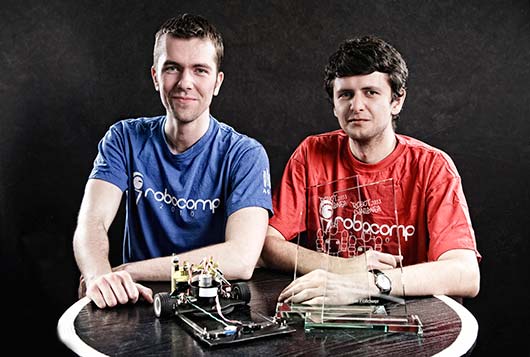
Mariusz Kaczmarek and Marcin Okarma with a double gold medalist robot Hurricane
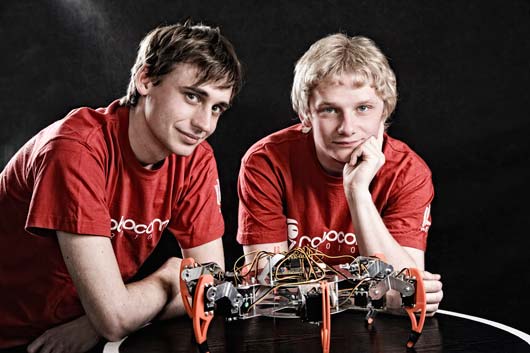
Integra students with robo-spider
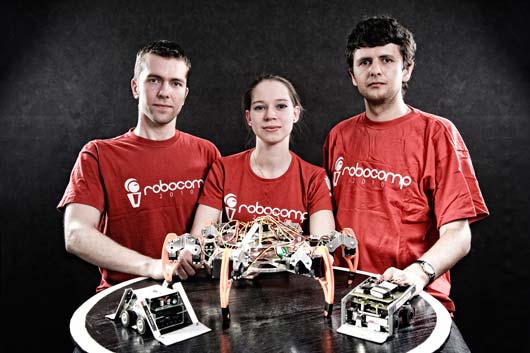
Also women construct robots (sumo and robo-spider)
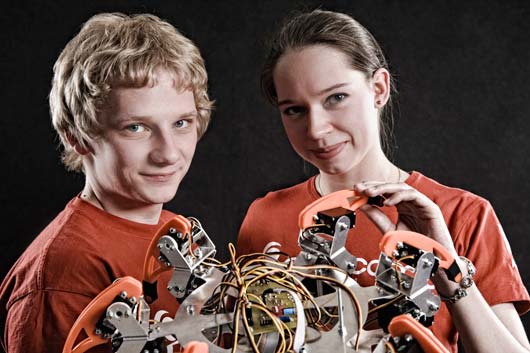
She, he and a robot...
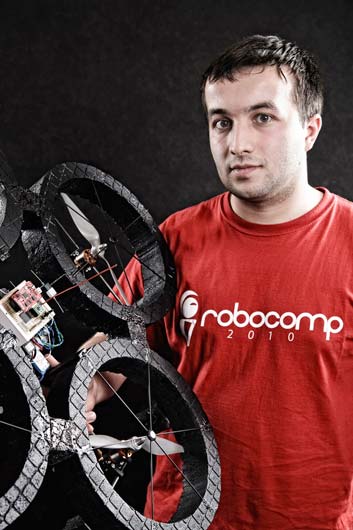
Four-engine helicopter is the latest "child" of Integra
On a daily basis they study and work at the Department of Automatics of the Faculty of Electrical Engineering, Automatics, Computer Science and Electronics. It was just here where four students - Przemysław Elias, Michał Gazda, Marcin Okarma and Mariusz Kaczmarek - organised for us a demonstration divided into two parts: the first part was a sumo wresting tournament, and the second one was timed-riding on a given track. The competitors are robots of various appearance and - usually imaginary - names, for example, Boczek (English: Bacon) or Forfiter. They fight against one another on a circular ring, the so-called "dohyo". The "wrestlers" have been programmed is such a way that they try to push their opponent out of the ring. Matches last up to three minutes, but often finish after just a few or several seconds. Our wrestlers are small, fast and very agile, and hence wrestling matches provoke truly sporting excitement both among the constructors and spectators. Another presentation took place on a large board with a marked track, on which a robot named G.enek - belonging to a category of the so-called "line followers" - moved with an incredible speed. G.enek's aims are: to reach the destination as quickly as possible, and to follow the marked line precisely (there is also a category of line followers with obstacles - the robot has to go round a barrier and get back onto the marked line.) The long and winding track is covered by G.enek in 3-4 seconds, which means his speed is between 1.5 and 2 metres per second.
One of the reasons why our students constantly improve their robots is to win tournaments, which were originally started in Japan and then spread all over the world. At present, many technical universities organise similar tournaments, among them the AGH University of Science and Technology. The last important tournament was the European Championships which took place in Vienna between 26th and 28th March, where nearly 300 machines from 17 countries gathered at the starting line. Our contestants - Marcin Okarma and Mariusz Kaczmarek - along with their robot "Hurricane" - achieved a great success in the capital of Austria, and returned to Poland with two gold medals! However, it was not Integra's first success. This year, the students of this special interest group already successfully presented their constructions in Wałbrzych on 21st January, in Warsaw on 5th March, and in Rybnik on 12th March, winning medals in various categories.
The cost of constructing a mini robot is at least several hundred PLN. The heart of each machine is a processor, and the constructor's task in not only to build a robot, but also to write a suitable algorithm for its operations. It is the algorithm and the construction which will determine what type of a robot it will be. There are the following categories: mini-sumo, line follower, micro-mouse (robots looking for a maze exit) and freestyle (all kinds of machines which do not fall into the previous categories).
Our constructors have been building robots and taking part in competitions for several years. A pioneer in this discipline is Marcin Kmieć, at present a doctoral student at the Faculty of Electrical Engineering, Automatics, Computer Science and Electronics. Przemysław Elias (4th-year student of applied computer science, 3rd-year student of automatics and robotics), Michał Gazda (3rd-year student of applied computer science, and Marcin Okarma and Mariusz Kaczmarek (4th-year students of automatics and robotics) hope that, once they have graduated from the university, the tradition of constructing robots and taking part in competitions will be taken over by their younger followers. It is more than certain, as "Integra", whose supervisor is Dariusz Marchewka, DSc, has already gathered over fifty individuals, among which there are a few female students.
The earliest opportunity to see the robots will be at the Robotics Festival „Robocomp", which will take place in the AGH-UST main building on 14th May, 2011. Will the machines of our students turn out to be unbeatable again? Just come and check it yourselves!
Story: Ilona Trębacz, Photo: Dawid Jach/KSAF AGH
All rights reserved © 2021 AGH University of Science and Technology