


12.04.2011
Robot of AGH UST works at cellular level
To insert a precise tool into an individual cell - no problem - anything is possible at AGH UST. Such a large improvement in microbiology is offered by a hybrid robot assembled at the Department of Robotics and Mechatronics of the AGH UST Faculty of Mechanical Engineering and Robotics, and has been possible thanks to three-year work of a ten-person team. The cost of works on the prototype amounted to half a million PLN.

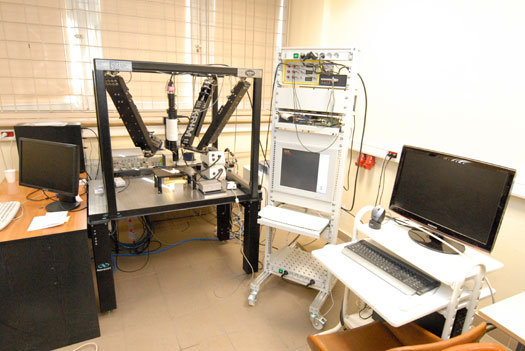
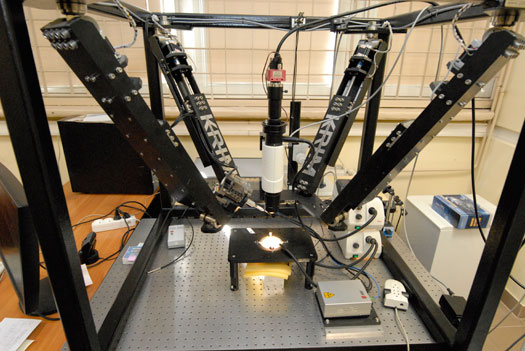
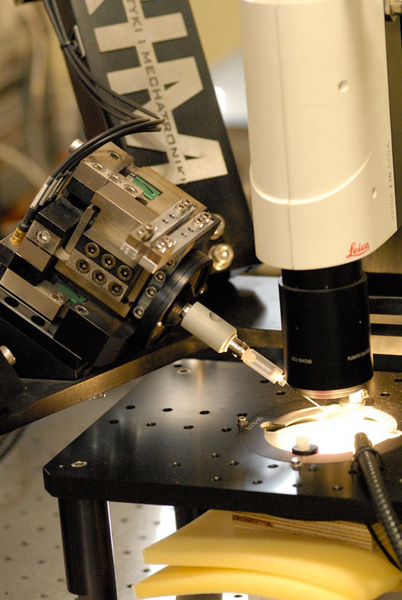
The robot is a hybrid. It consists of two parts: macro and micro. The macro part of the robot looks for cells in the examined material, the micro part is designed to operate on the cells. The tests for which the robot has been designed were possible even before its construction, but they required a great deal of precision and physical strength on the side of researchers, as the experiments sometimes took several or a dozen hours.
A rapid development of biotechnology requires more advanced techniques of operation at a cellular level, as well as inside the cell. For this purpose, the types of manipulators used are manual or drive-based, ones using telemanipulation, which requires supervision by an experienced operator, who controls the process visually, or through a microscope. Some research requires the tool to be kept in the same area of a cell for many hours, which is difficult to achieve due to the natural movement of cells, as well as the displacement of the tool caused by the thermal elongation of the manipulator elements, and the relaxation of stress which takes place during movement. In the case of electrophysiological examination with the use of the patch-clamp technique, there are additional difficulties:
- a small space for operation, which results from the use of microscope optics, whose characteristic feature is a small distance (around 2 millimetres) between the lens and the examined material,
- a necessity to work in near infrared radiation in order to achieve a suitable depth of visualisation in the examined tissue (about 100 µm), wherein too large intensity of lighting causes unacceptable heating of the tissue,
- an unacceptability of electrode displacement in relation to the cell by more than 1 µm during the measurement process,
- an acceptability to generate magnetic interference due to a very small intensity of the measured current (of the order of pA); for this reason, there has to be a possibility to place the examination stand in a Faraday cage,
- the fragility of the submicron tip of a micropipette, which acts as a measurement electrode, which, in order not to be damaged, needs to be inserted into the tissue axially.
Within the framework of the project, the problem of intercellular manipulation has been resolved by means of using a visually-controlled hybrid robot with a parallel macromanipulator of four freedom degrees, a serial micromanipulator of three freedom degrees attached to it, flexible joints driven by piezoelectric drives, capable of moving precise tools, as well as cameras with a macroscopic optical system of large magnification.
Using a unique algorithm of image processing enables the reproduction of information regarding the third dimension, the safe movement of the tool near and inside the cell, as well as the long-term stabilization of the cell-tool relative position.
Performing time-separate operations on macro and micro scale has made it possible to eliminate electromagnetic vibrations and interference resulting from the macromanipulator, whose drives are switched off during the process of micromanipulation. Using a parallel macromanipulator enables an easy and unlimited selection of the experimental tissue area, and a much easier - in comparison to contemporary solutions - replacement and maintenance of tools and biologicals. Using a macroscopic optical system has substantially increased the distance between the lens and the examined material, creating a large space for manipulation. The base (frame) of the macromanipulator also enables the installation of a Faraday cage.
Although the first use of the robot is to provide support in patch-clamp examination, it has been designed in such a way that it enables, after adding another micromanipulator, to carry out some various biological experiments, such as research into the retention of in vitro cells after the intra-cell injection of substances stimulating and inhibiting their development. It requires locating a suitable cell in the solution, wherein the search area for a suitable cell substantially exceeds the space of proper manipulation, and the visual field of a stationary microscope. In the next step, the located cell is picked up with the use of a micropipette in order to make it motionless, and another micropipette, through which the injection is carried out, is used to cut precisely through the cell membrane in such a way that it is not damaged; after the injection, the micropipette is withdrawn carefully. This method can also be used to replace the selected elements of a cell interior, for example a nucleus or cytoplasm, which can be applied in genetic engineering or artificial fertilization.
A characteristic feature of a parallel robot of a modern kinematic structure is the existence of an analytic solution of forward and inverse kinematics, high precision and positioning resolution, a low level of electromagnetic interference, and good vibration damping. The original construction of the robot ensures the high precision of movement in a relatively large working space, and very good vibration damping. For both the robots, the constructors have designed trajectory generators, as well as a control system ensuring the required precision of trajectory tracking and positioning. Information as to the mutual position of the tool and the manipulation object (cell) is delivered by a visual system, part of which is a macroscopic visual track of controlled parameters, a high resolution camera, a lighting system, as well as the algorithms of image processing and analysis.
On the basis of the worked-out methodology, the algorithms of image processing and analysis have been implemented into the FPGA system, which allows to carry out the activities of processing and controlling in real time. The robot is equipped with a dedicated, intuitive human-machine interface in the form of an operator's panel, equipped with a touch screen, which enables to select an operation, modify parameters, and constantly monitor the preformed manipulation by means of showing the processed image from the camera.
The prototype of the robot has been awarded a gold medal at the Poznań International Fair 2009.
Story: Zbigniew Sulima / Maciej Petko, Photo: Zbigniew Sulima
Tr.: Grzegorz Kłopotowski
All rights reserved © 2021 AGH University of Science and Technology