


28.04.2011
„Lightning shooting upwards” – mysterious discovery by Stanisław Staszic
Among hundreds of university students, employees and guests walking every day up and down the stairs past the figure of Stanisław Staszic, is there at least one person who associates the patron person of our university with his achievements in the field of... lightning physics? Yet it is a fact that Staszic is attributed with the observation of the so-called "upward stroke" or "ground-to-cloud lightning", give or take, 125 years before its official discovery (Karl Boyer McEachron in the 1930s). However, in the light of contemporary knowledge, the matter is quite controversial. Let's start from the beginning...
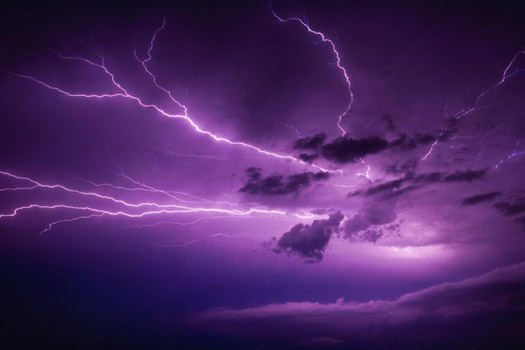
Foto: http://burze.dzis.net
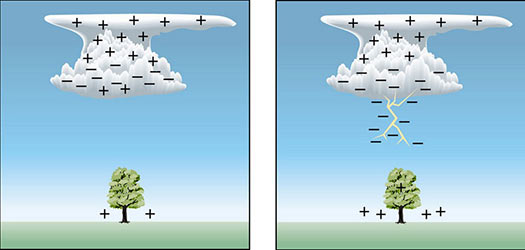
Picture 1. Phases of lightning development in a picture obtained by the fast rotating camera.
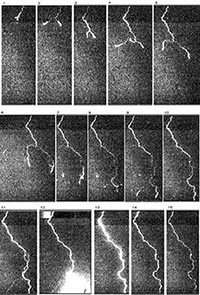
Picture 2. Development of a leader (photographs 1-10) and the main discharge (photographs 11-15); the image of the leader becomes "covered" by the flash of the main discharge. Source: http://wsx.lanl.gov/images/lightzap.gif
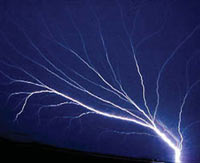
Picture 3. St Elmo's fire in a very clear form. Source: http://www.stormtrack.org
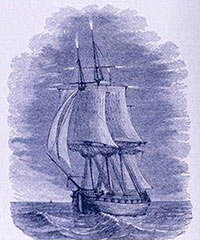
Picture 4. St Elmo's fire on a ship at sea. Source: Wikipedia
Professor Stanisław Szpor (the most eminent researcher of lightning discharges), while preparing to examine the lightning threat to stone pine, got hold of the 1815 work by Stanisław Staszic O ziemiorództwie Karpatów i innych gór i równin Polski, rozprawa trzecia O Wołoszyni, o Pięciu Stawach i Oku Morskim (English: On the Soil Fruitfulness of the Carpathians and Other Mountains and the Plains of Poland, the third Treatise on Wołoszyn, Dolina Pięciu Stawów and Morskie Oko); professor Szpor used the 1955 edition. His attention was drawn by a description of a thunderstorm in the Tatra mountains:
"Surrounded by this dreadful darkness; it was raining heavily; and higher above us there were large amounts of snow, which had completely covered the cracks and chasms between the rocks. And nearby, one could feel the rocks trembling and hear uncomfortable rumbles; continuous lightning strokes and flashes. Most of them seemed to shoot upwards from the mountain peaks, rather than strike the rocks from above."
Szpor was particularly excited about the last sentence: "Most of them seemed to move upwards from the mountain peaks, rather than strike the rocks from above." He concluded that what Staszic had seen was ground-to-cloud lightning, which he had distinguished from typical downward strokes, located them (move upwards from the mountain peaks), and even assessed their quantity (most of them)! Szpor placed the above description at the beginning of his article "Polish Lightning Results" (monthly Problemy, no. 7/1958, pp. 425-431), entitling the chapter "Staszic - 125 years ahead of McEachron".
By the way, that was probably the last publication of this Gdańsk researcher before the forced limitation of his research activity; on the wave of the "March events", even though he had nothing to do with their "Zionist mainstream", he was deprived of his Chair at the university and asked to retire early for, as it was described later, "contesting communism". A nice surprise can be the nonconformism of the editors of Problemy, who placed the text in the section "From our research laboratories" (issue no. 8 was sent to print on 9th June, 2011); Józef Hurwic, the contemporary editor-in-chief, was also soon dismissed from the job (and even forced to emigrate). A sign of the times! (Professor Stanisław Szpor died in 1991; professor Józef Hurwic, a physical chemist, lives in Paris, and turned 100 years old in May 2011!)
No surprise that Staszic's discovery is still present in reference books (for example, see the paper by Chrzan K.L., Marciniak R. History of Lightning Protection in Poland, Proceedings of 26th ICLP, Cracow 2002.) But let's stop these historical speculations and verify the discovery in the light of contemporary knowledge.
Is it possible that Staszic could see the direction of lightning development?
The analysis must be linked to a short recapitulation of the phenomenon physics, restricted to the most important points. As we know, lightning is a discharge between the centre of an electric charge in a storm cloud and the earth. The direction of the current, determined by the polarisation of this natural capacitor, remains unchanged throughout all the phases of the discharge, is unnoticeable to human eye, and Staszic's observations can have nothing to do with it. (By the way, about 90% of all discharges carry electrons from a cloud to the earth, and only about 10% the other way round.) Lightning can be single or multiple (the subsequent "flows" of an electric charge follow the route traced by the first discharge.) A single discharge appears to us as a single flash of a twisted, often forked line joining the cloud with the earth; a multiple discharge appears as a series of flashes lasting several tenths of a second; the flashes are sometimes mutually shifted.
The flash mentioned above (both single, and one being part of a series in multiple lightning) appears to the observer as immediate on its whole length. Only the rotating camera, used for the first time by B. Walter at the beginning of the 20th century, made it possible to find out about the complex dynamics of a discharge, and the stages of its development. In the leader phase, a spark whose electric current intensity equals several hundred amperes, is a line started in a cloud, elongating towards the earth. It happens in a form of steps (segments), each being several dozen metres in length; after the development of a segment, which takes about one microsecond, there takes place a break which lasts several dozen microseconds, and the next segment is created (pictures 1 and 2). The whole process can be compared to opening a "fresh" telescopic antenna - you need to strain for a while before you pull out another section.
When the lower part of a leader is between two hundred and several dozen metres above the earth, the so-called "upward leader" launches, usually from the highest point on the ground, in order to meet it. After they join together, the main discharge, which is now of a thousand times greater electric current and velocity than in the leader phase, moves upwards through a created plasma channel.
Until the 1930s, it was assumed that the leader always developed from a cloud to the earth. Only the above-mentioned research by McEachron on the 400-metre-tall Empire State Building in New York (the highest skyscraper in the world at the time) led to a discovery of earth-to-cloud discharges (the segments of the leader "climb" upwards.) It was soon determined that such discharges began at tall objects (natural or artificial) which were at least 200 metres in height, but they were overwhelming in the case of the tallest ones (television transmitting aerials, mountain peaks). It must be emphasised that the tests were carried out with the use of a rotating camera.
Staszic, if he had been to recognise the direction of a discharge with the naked eye, he would have had to see the development phases of a leader - a thousand times slower than the main discharge. But was he able to see the direction of segments building up? A very rough estimate (but there is no other possibility): an average 2.5-kilometre spark of a leader consists of 50 segments, each of an average length of 50 metres. If the "inter-segment" breaks in a discharge are about 50 microseconds, the duration of a leader can be estimated to be 2.5 milliseconds. At the same time, it is the time interval between the first and the last segment (step). And here are the doubts... According to contemporary knowledge in the sphere of visual perception, we cannot see stimuli lasting less than 40 milliseconds! For example, in 1998, M. Bar and I. Biederman found out that a picture displayed for 47 milliseconds could only be seen by one in seven examined people (see Bar M., Biederman I. Sublimal Visual Priming, Psychological Science, no. 9/1998, pp. 464-469.) A leader discharge lasts at least a dozen times too short for an observer to notice the direction of spark development! At the most, one can see a static "hot" sign in the air. This conclusion cannot be disputed by otherwise justified remarks that the evaluation of a leader duration can be underrated, and the value of visual perception overrated, that the latter is very individualised, that lightning in the Tatra mountains is very specific, and so on. The proved disparity between the perception threshold and the time of a leader development is simply too large...
So what did Staszic really see?
According to the author, they were probably incomplete discharges, described in the lightning physics and lightning protection as streamers, also commonly known as St Elmo's fire. It appears in stormy conditions of a strong electric field between a cloud and the earth. St Elmo's fire starts before or during a thunderstorm on the edges of roofs, rocks, masts, and aerials. It can even happen on a stretched hand (the author knows an employee of our university who experienced this phenomenon at the Widok housing estate in Krakow.) St Elmo's fire is hardly visible in daylight, but at dawn or dusk, at night or when the sky clouds over heavily, it can be seen in the form of glowing "little brooms" (picture 3). The easiest way to see this phenomenon in the mountains or at sea - on the masts and ropes of ships (picture 4). Its name comes from the name of St Elmo - the patron saint of sailors.
If we want to verify Staszic's observations, we need to avoid the mistake of ahistoricism. At the beginning of the 19th century, there was no theory of lightning, not to mention a dynamic one, the notion of electric current was in its infancy (an electron was to be discovered only after several decades!), and an electric arc (some sort of equivalent of an atmospheric discharge) was created for the first time in Humphrey Davy's London laboratory only in 1811 (the work On the Soil Fruitfulness... was written nearly at the same time.) Staszic, surrounded by dreadful darkness, amidst flashes and thunders, seeing "fires" at the peaks of the mountains, had a full right to take them for lightning shooting upwards, and since the phenomena outnumbered the real lightning, he wrote that there had seemed to be most of them.
Bus this is only a hypothesis of the author, written by a shaking hand, as it undermines an opinion of a great authority - professor Stanisław Szpor. Perhaps the mystery of Staszic's discovery will never be solved...
Story: Dr inż. Marek Szczerbiński
Tr.: Grzegorz Kłopotowski
All rights reserved © 2021 AGH University of Science and Technology