


12.10.2015
Computer programmers and geologists present intelligent flood bank
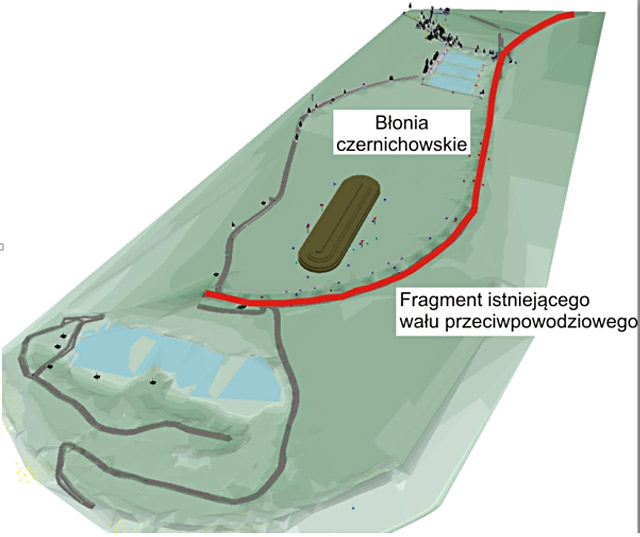
On 30th September, 2015, Czernichów near Krakow hosted a presentation of the measurement capabilities of one of Europe’s most advanced experimental flood banks. The leader of the project is the AGH University of Science and Technology.
A unique research laboratory, which, in short, can be called an “intelligent flood bank”, will eventually be equipped with a set of over 1,200 specialist sensors. The bank was built on the floodplain of the Vistula river near the School of Agriculture in Czernichów within the framework of the project “Computer System for Monitoring River Embankments”. The main assumption of the experimental flood bank will be the development of a complex system supporting the state and local authorities in the area of flood protection.
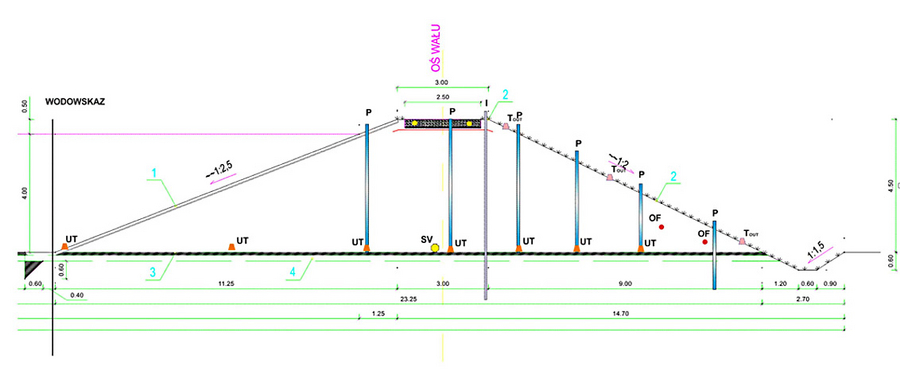
The Computer System for Monitoring River Embankments aims to collect information regarding the processes occurring in the flood bank, the optimisation of data transfer, as well as its interpretation and analysis by means of numerical simulations. An innovative aspect of the project is the use of a number of sensors which monitor changes within the boundaries of the bank, and later compare them with the results of numerical simulations. The suggested solution will make it possible to forecast the condition of the embankment as well as the threats following the soaking of the soil. In the flood bank, which resembles a sports stadium, it will be possible to carry out the simulations of flood conditions. The monitoring system inside the embankment enables the measurement of pore water pressure, temperature, soil pressure, as well as other parameters. The total cubic volume of the construction exceeds 28 thousand cubic metres, and it is over 4 metres high and 200 metres long.
The scientific and industrial consortium, part of which are two AGH UST faculties (Faculty of Geology, Geophysics and Environmental Protection and Faculty of Computer Science, Electronics and Telecommunications), has set itself a target to collect measurement information in a continuous mode, to interpret and analyse measurement results with the use of computer simulations, as well as to provide suitable authorities with visualised results. All this to find out about the best methods of building, protecting and monitoring flood banks.
Detailed information about the project can be found at: www.ismop.edu.pl/en
All rights reserved © 2021 AGH University of Science and Technology