


20.05.2016
AGH UST students develop energy harvester
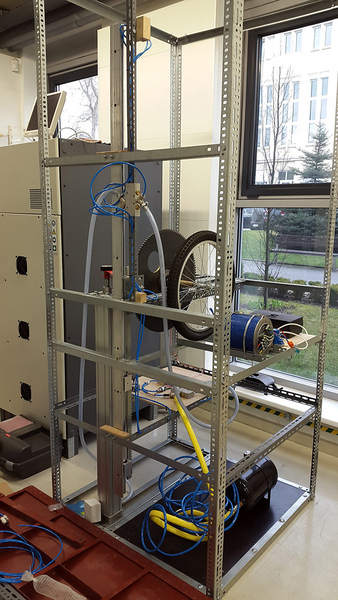
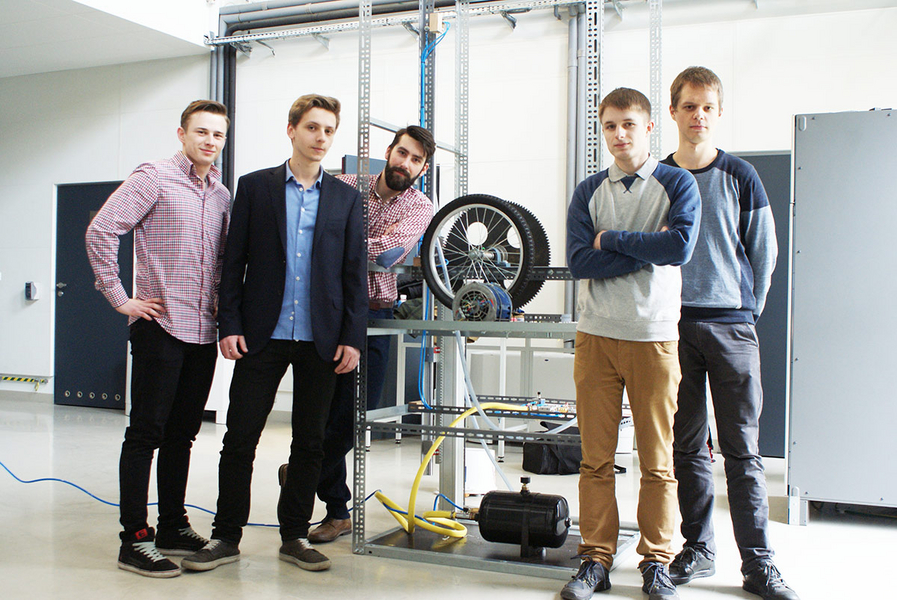
An innovative device for the recovery of energy from compressed air and its conversion into electrical energy has already been patented, has passed industrial tests – and what is even more important – it has already been enjoying an avid interest from industry.
The idea of the invention was born in the Special Interest Group “Hydrogenium”. On the initiative of professor Janina Molenda of the Faculty of Energy and Fuels, the supervisor of the Group, 11 students led by professor Jacek Leszczyński (Department of Hydrogen Energy at the Faculty of Energy and Fuels) began work on the development of the invention. During the conception and construction phase the team changed a few times, and currently its members are the students of the Faculty of Energy and Fuels: Krzysztof Kastelik, BSc, Dominik Gryboś, BSc, and Bartłomiej Tomasiak, BSc, and the Faculty of Mechanical Engineering and Robotics: Ryszard Kamiński, BSc, and Miłosz Olszewski.
The energy harvester uses the waste energy of compressed air released into the atmosphere and converts it into electrical energy. Thanks to it, the invention can be used in all kinds of pneumatic systems – that is wherever compressed air is used.
Within the framework of the conducted research, the students have built a technology demonstrator (of dimensions 1 m x 1 m x 3 m). The operation of the device is based on a principle that the gas tank (acting as a buffer for the energy of compressed air) is loaded up to a specified low pressure. The nature of the invention consists in the fact that the entire system works at a very low pressure (typical pressure in an installation equals 6-8 bars, and the energy harvester from AGH UST works within the pressure range of 1-0.7 bar). The working principle of the demonstrator has been protected by patent application no. P.414139 at the Polish Patent Office. Currently, the application is in the phase of publication.
“In order to construct the device we needed knowledge, skills and practice – and the biggest challenge for the team was the integration of the constituent elements. What is important, research in the field of low-pressure pneumatics is in a pioneering phase, as this issue has until now been neglected. Pursuant to classical theories, our invention should not work, as any loading put on the outlet ports of the air released into the atmosphere from any pneumatic system should disturb, slow down or halt the system. However, this does not really happen in practice. We are wondering why,” says professor Jacek Leszczyński of the Faculty of Energy and Fuels.
Thanks to the established contact with industry – the most important phase for the research team were two technological tests, which were conducted in food and automotive companies.
“Connecting to a system of pneumatic automation, where air is released into the atmosphere after performing work, we can use the air to produce electrical energy, and what is important – we do not disturb the operation of these systems,” emphasises Krzysztof Kastelik, BSc.
After two industrial tests of the energy harvester, both companies commented that the test were performed without any problems, which is a great success of the AGH UST constructors. What is more, both companies have already expressed their interest in further tests of the device until it goes into the phase of implementation into production.
The financing of the project was initially based on the funds from a “Rector’s Grant” as well as the financial support from the Dean of the Faculty of Energy and Fuels – professor Wojciech Suwała (ca. 9,000 PLN). As the project developed – more funds were obtained from a private investor (5,000 PLN), as well as the companies MAGNETO Sp. z o.o. and Haffner Sp. j. (4,500 PLN), which enabled the young constructors to purchase some indispensable parts, such as actuators, transmissions, etc.
The scope of the industrial application of the energy harvester is extremely wide and encompasses all companies and plants where pneumatic systems are in use, for example, in food (packaging devices or bottle-shaping machines) and automotive industries. Scientists have also estimated the initial capital expenditures and the time needed for return on investment. In the case of energy conversion for a plant’s own needs, it can be estimated with an approximation of 20% that the time needed for return on investment is about 3.2 years. Such a length of time is at an acceptable level from the economic point of view. What is more, the AGH UST inventors can also see a huge potential of the device in a different function – as a road hump (in such places as petrol stations and car parks, e.g. near supermarkets), but work on this type of application is still in the construction phase.
At the moment, the technology demonstrator is at the 5th level of readiness according to TRL. The ambition of the team is to reach level 9, that is the installation of a ready-to-use system at a potential client’s premises. In the near future, the students are planning to conduct technological tests at two more companies, which have already expressed their serious interest in participating in the project. During the summer holidays, the team are planning to modernise the energy harvester. The scientists are also negotiating the implementation of the device with various companies. The design, construction and launch of the first device in an industrial plant is possible within a year from the moment of receiving an order.

Virtualisation of technology demonstrator: (1) Gas tank; (2) System of pressure management; (3) Toothed gear; (4) Current generator; (5) Loading control system – author: Miłosz Olszewski
The installation consists of a pneumatic control system, an actuator with a toothed bar, a toothed gear and a friction gear, and a current generator propelled by them, together with a loading system. Waste air released from production lines through outlet valves is pushed through pneumatic ducts to the equalising tank. The air is stored in the tank until it has reached a desired working pressure. Then, some part of the air is moved from the tank to a system of valves responsible for maintaining the working pressure of the system at a suitable level. A pressure sensor opens a voltage-controlled valve and passes the medium on to the system of valves which ensure the regular operation of the system. From the control valve, the air is pushed directly to the cylinder of the actuator, which initiates the movement of the piston rod. The movement of the piston rod causes an alternate releasing and pressing down of additional control valves, which results in the resetting of both control systems. The piston rod, which is connected to the toothed bar, ensures the conversion of translational motion into rotary motion by means of a toothed wheel placed on a shaft with a one-way clutch. On the same shaft there is a friction gear coupled with the shaft of the current generator. Any increase of pressure in the tank above a predetermined value results in the activation of the pneumatic system and a movement of the piston rod, and in consequence, the rotation of the shaft of the gear and the current generator. The energy produced by the generator is directed to batteries through a system of capacitors and a special electronic conversion system. A surplus of the charge is directed to a protective light bulb.
All rights reserved © 2021 AGH University of Science and Technology