


20.11.2018
AGH UST Solar Plane the best student constructional project
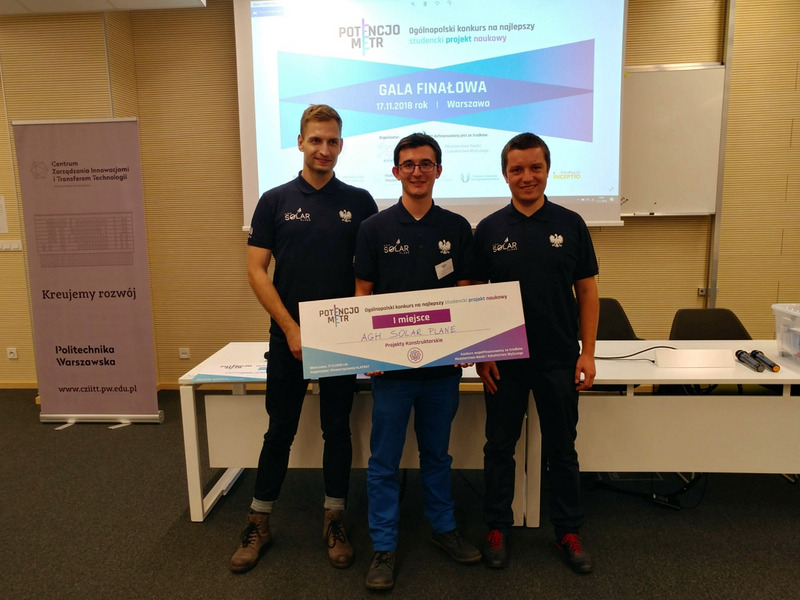
Representation of AGH Solar Plane – from the left Jakub Wiszniewski, Bartosz Sobik (students) and MSc. Krzysztof Sornek
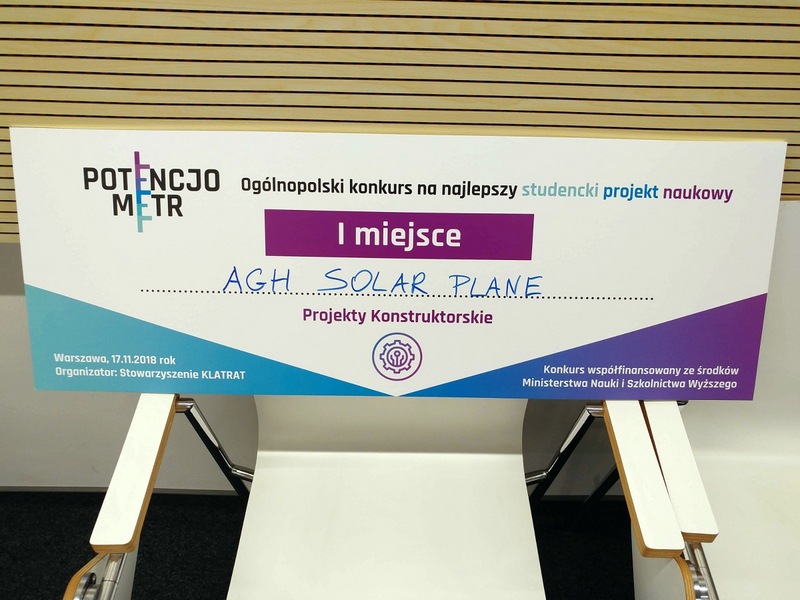
In the Polish competition for the best student scientific project POTENCJOmetr, the project of an unmanned plane powered by solar energy AGH UST Solar Plane has been voted the best constructional design. Thanks to the application of an energy storage system and taking advantage of energy collected during the day, the aircraft will be capable of staying in the air for the whole night. In the justification of the decision, the expert members of the jury drew attention to a high innovativeness of the project and its huge potential in the context of the development of electromobility in Poland and around the world.
The plane is an example of a combination of modern technologies in the field of electromobility and the renewable sources of energy. A specially designed shape of the particular elements of the machine, ultralight and durable materials, efficient photovoltaic modules, and state-of-the-art batteries – these are only some examples of the innovative solutions that have been used in the designed aircraft.
The winning project team is composed of the members of the Student Special Interest Group “AGH UST Solar Plane” at the Faculty of Energy and Fuels. Currently, it comprises 50 people representing 10 different AGH UST faculties. The scientific mentor of the team is Krzysztof Sornek, MSc, of the Department of Sustainable Energy Development. The coordinator of the project is Aleksandra Szeląg, a student at the Faculty of Energy and Fuels.
The idea to build an unmanned airplane powered by solar energy emerged in October 2017. The students started their work with the phase of planning and modelling. In march 2018, they moved on to the phase of construction. In order to test the efficiency of electronics, they first built a model made of modelling foam. After the tests, they started to assemble a prototype with a 3-metre wingspan. This phase is nearly finished. They are now planning to build a final model, whose wingspan will be about 5 metres.
Constructing a plane designed for the so-called “endurance flights” requires a particular optimisation of parameters. The construction will use an environmentally-friendly power supply system – the source of energy feeding the entire system will be photovoltaic cells located on the wings of the plane. Specially designed panels will make it possible to achieve optimum aerodynamic performance, and the structure made of highly resistant and very light material, i.e. carbon fibre, will ensure a high durability of the construction. One of the main engineering problem that the team will have to face will be a system of energy management. In the case of adequate insolation, propulsion motors and on-board electronics will be powered directly from photovoltaic cells, and the surplus of generated energy will be stored in lithium-ion batteries. In a situation when the amount of sunlight is inadequate, the shortage of energy will be replenished thanks to the charged batteries. And in the case when the amount of solar energy is higher than required, the plane will be able to ascent in order to gain additional potential energy related to height.
One of the priority and most interesting issues will be designing a headtracker and its own software for processing data obtained from the on-board avionics computer and a large number of sensors. The most important part of the headtracker will be a camera located on the fin, which will transmit pictures to the operator. The pilot flying and controlling the plane from the ground will be equipped with VR goggles thanks to which (s)he will be able to see images from the camera located on the board of the plane. This will allow the pilot to analyse any phenomena taking place on the skin of the entire aircraft. Another task for the team will be creating a database which will encompass the parameters of the airplane and a live view in real time.
A final phase of the project will be a flight of the finished plane between the north and the south of Poland, along the eastern border of the country. The team have already held initial talks with the Civil Aviation Authority about a precise route of the flight. The team are also planning to take part in the international competition of solar-powered aircraft “TÜBİTAK International Unmanned Aerial Vehicle Competition”, which will take place in Turkey in October 2019.
Alongside building the plane, an important objective for the AGH UST Solar Plane team is education and information in the area of raising social awareness related to the possibilities of the implementation of environmentally-friendly innovative solutions in the field of transportation. The students are planning to create a series of educational and training videos dealing with the subjects of modelling, photovoltaic systems, energy storage, microcontrollers, etc.
The Polish nationwide competition for the best student scientific project POTENCJOmetr aims at the activation of students in special interest groups and improving their soft skills. The organiser of the event is the Association of Students and Graduates of the Faculty of Chemistry at the Warsaw University of Technology “KLATRAT”.
The projects were assessed in three categories: constructional projects, social projects, and life science projects. Within the framework of each category, the best teams were chosen, and their representatives took part in a two-day training dedicated to giving professional project presentations, as well as building, communication, and the management of efficient project teams.
The final part of the competition took place on 17th November 2018 during the competition gala at the Warsaw University of Technology. In total, 29 teams presented their projects (including 12 teams in the category of constructional projects). Each team had only four minutes to present their achievements. After the presentation, the expert members of the jury and the audience had a chance to ask questions related to the project.
All rights reserved © 2021 AGH University of Science and Technology